RESEARCH PROJECT

The Emoting City

Emotion-Aware Architecture for Urban Spaces

Affective Computing Responsive Architecture Urban Interaction Design

Logo for the B-City Biennale of Urbanism and Architecture, featuring a black background, white geometric design, and text in English and Chinese.
Stylized number 5 in white on a black background, with a small white circle above it, resembling a simplified face or cartoon character.

The Emoting City is a research project exploring how responsive architecture and AI-driven emotion detection can transform public environments into emotionally intelligent systems. By integrating ambient sensing, facial recognition, and kinetic components, the project envisions spaces that adapt to human affect — fostering play, connection, and social awareness in real-time.
WHY?

Emotions are central to human experience, yet our cities remain indifferent. The Emoting City challenges this by proposing emotion-aware systems that turn urban infrastructure into empathetic environments.

WHAT?

An experimental architecture prototype blending emotion recognition with kinetic feedback. The Emoting City proposes a future where the built environment responds to social cues and psychological states.

HOW?

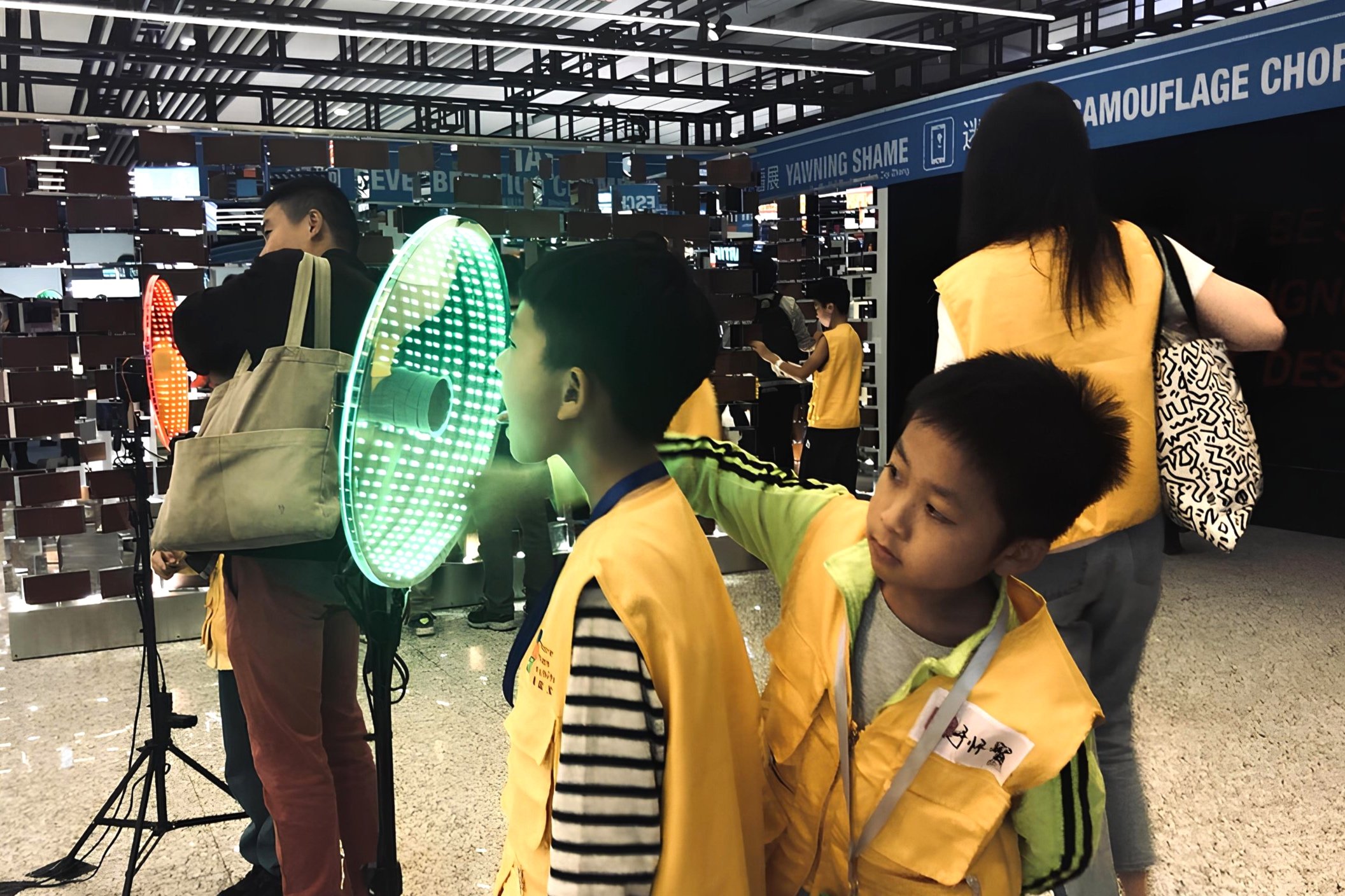
The system uses AI-powered expression analysis and ambient sensors to detect affective states. These inputs dynamically trigger changes in light, color, and kinetic surfaces to reflect or reshape mood.

WHERE?

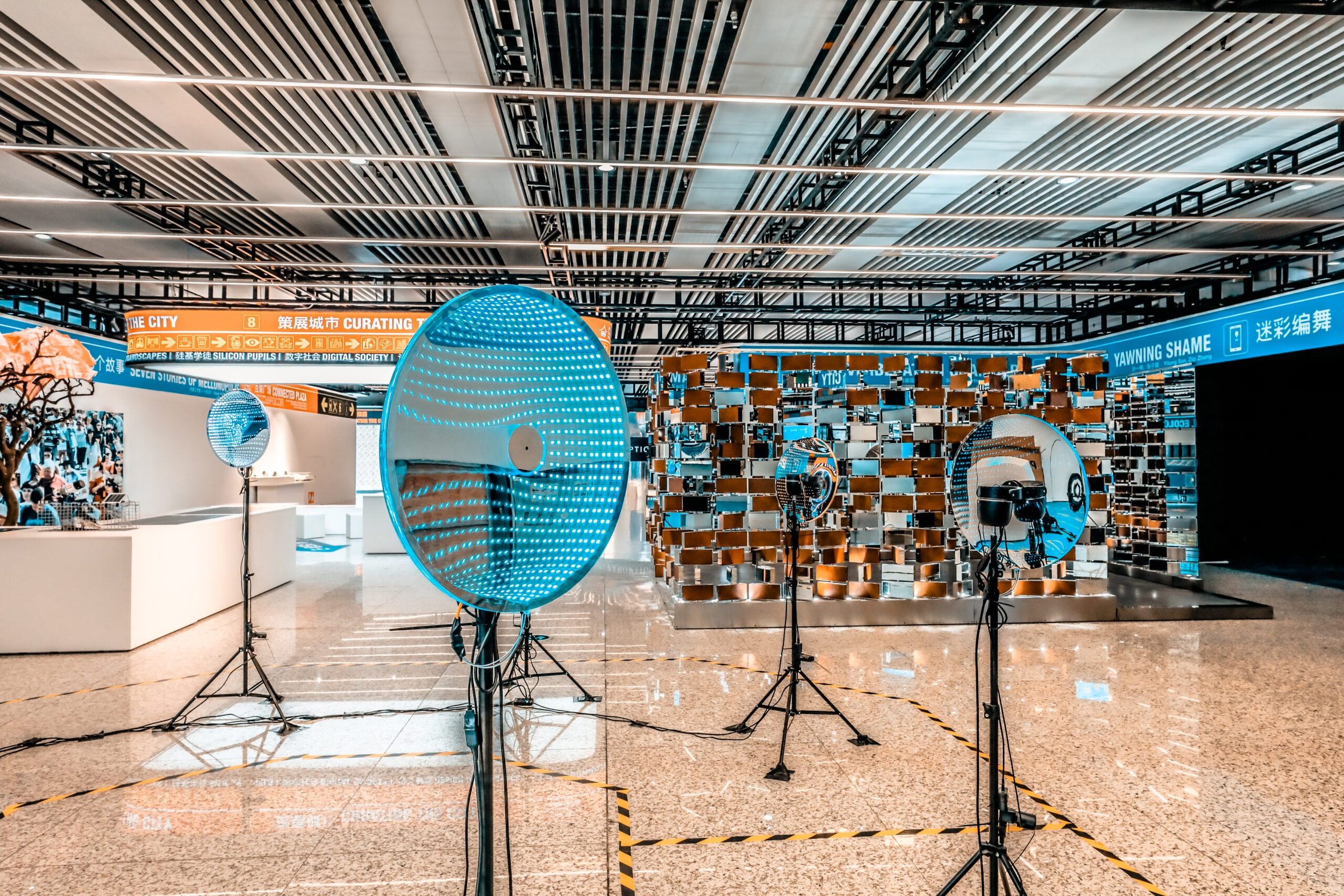
Installed at the Futian Railway Station as part of the Eyes of the City exhibition at the Shenzhen Biennial 2019, and featured in global research symposiums and platforms.

WHEN?

The project was started in 2019 and exhibited at the Shenzhen Biennial 2019, and has since evolved through multiple research iterations, publications, and public presentations.

WITH?

Developed in collaboration with the Dubai Institute of Design and Innovation DIDI, and the In5 Design Incubator and prototyping lab, supported by HAX Accelerator Shenzhen.

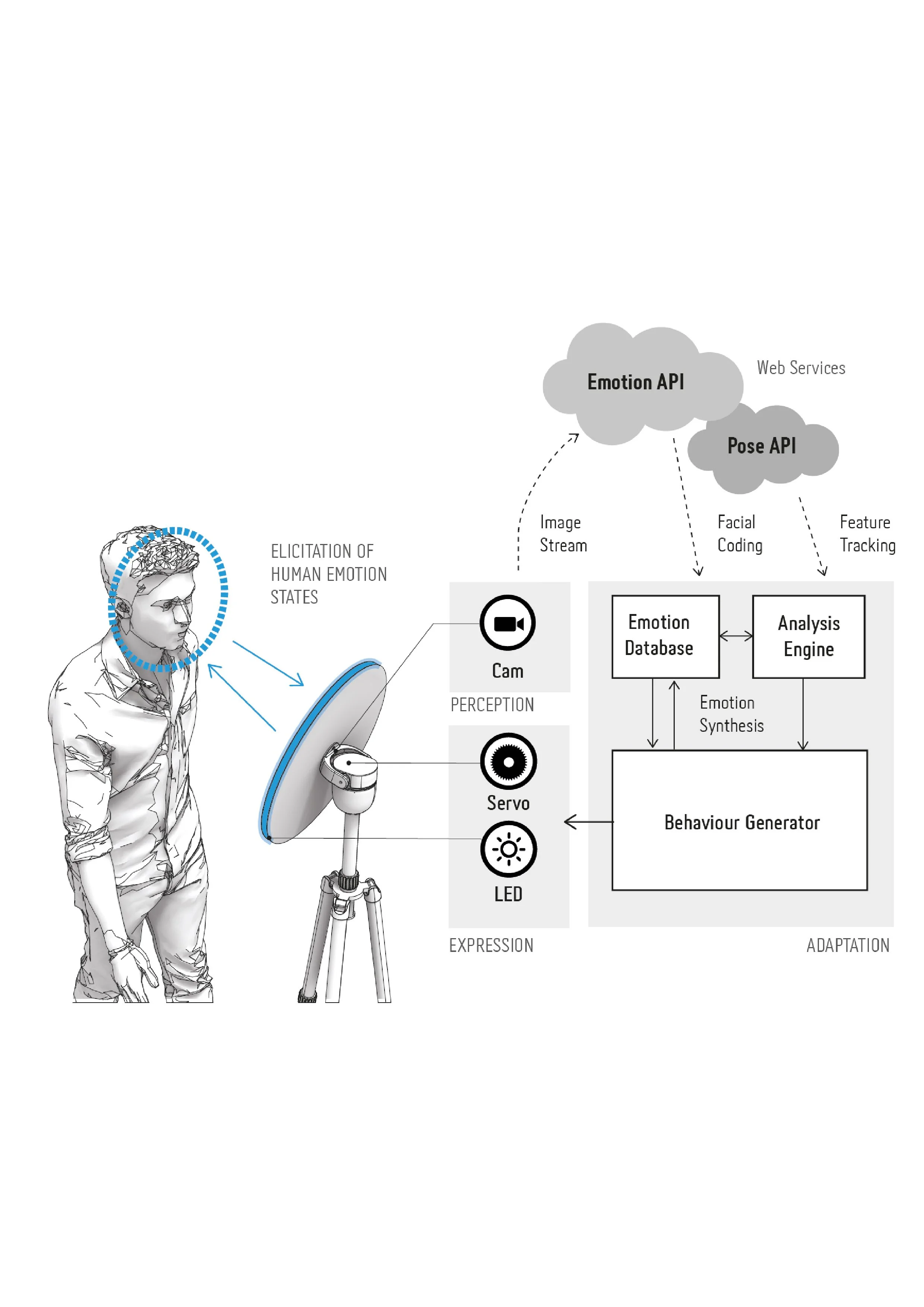
Diagram of The Emoting City’s distributed emotional sensing system with bots collecting user data and sending it to a shared affective intelligence cloud
Diagram showing The Emoting City’s AI emotion detection system with facial tracking, emotion APIs, and adaptive behavior output
Exploded view of The Emoting City’s emotion-sensing hardware, showing servos, LEDs, acrylic layers, camera, and wireless communication components
A complex infographic illustrating AI concepts including autonomous agents, digital perception, and emotional databases, with symbols representing cars, robots, and human figures in a 3D grid.

LINKED PUBLICATIONS

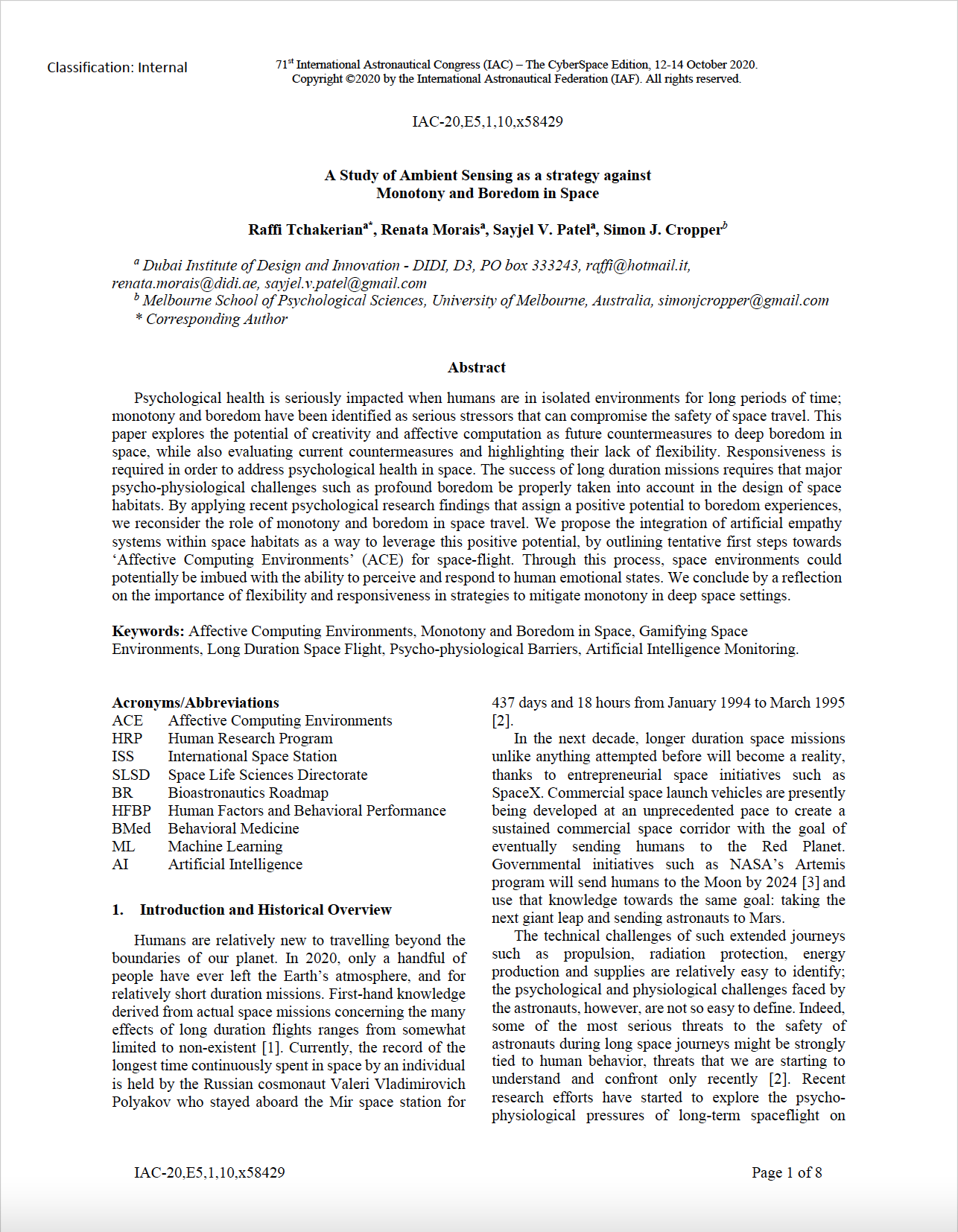
Page from a research paper titled 'A Study of Ambient Sensing as a strategy against Monotony and Boredom in Space,' with authors and abstract, discussing psychological health, space missions, and artificial empathy systems.
Page from an academic paper titled "The Emoting City" discussing designing feeling and artificial empathy in mediated environments, with authors' names and affiliations, and introductory text about the architecture of emotionally responsive environments.
Astronaut looking out of a window at Earth from space, with view of clouds and blue ocean
Title page of a research paper titled 'Ambient Sensing and Elicitation of Human Affective States To Combat Monotony and Boredom in Space' with authors Raffi Tchakerian, Renata Morais, Sayjel V. Patel, and Simon J. Cropper. Contains abstract, keywords, and abbreviations.
Page from an academic paper titled "The Emoting City" discussing designing feeling and artificial empathy in mediated environments, with author names, affiliations, and keywords listed.

CREDITS

Concept and Strategy: Dr. Raffi Tchakerian, Sayjel Patel, Jie Zhang

Technical Development: Andrei Razvan Baluta, Muhammad Shaziab, Alhaan Ahmed

Academic Parnter: Dubai Institute of Design and Innovation, DIDI

A computer monitor and a smartphone displaying maps with a focus on transportation routes and mobility data. The screens show a minimalistic map of a city with red markers and labels related to mobility.

RELATED PROJECT

Shape Your City

Citizen Engagement Platform for Dubai Masterplan 2040

Interactive Data Visualization App Design & Development Interactive Installation

White RMAJM logo on a black background.
Springer logo with stylized chess king and the word "Springer" in white on a black background.
Black background with white text that says "RESPONSIVE CITIES COLLECTIVE INTELLIGENCE DESIGN" with diagonal striped pattern elements.
Logo for Dubai Design Week with the text 'dxb' and 'Dubai Design District' against a black background.
Digital logo with the word 'DIGICOM' arranged inside a 3D cube outline.