
OUR SERVICES
AI Workshops & Opportunity Discovery
Where could AI make a meaningful difference to your work?
Find the opportunity. Build the capability. Test the next step.
We help organizations turn interest in AI into practical opportunities, informed decisions and the ability to move forward.
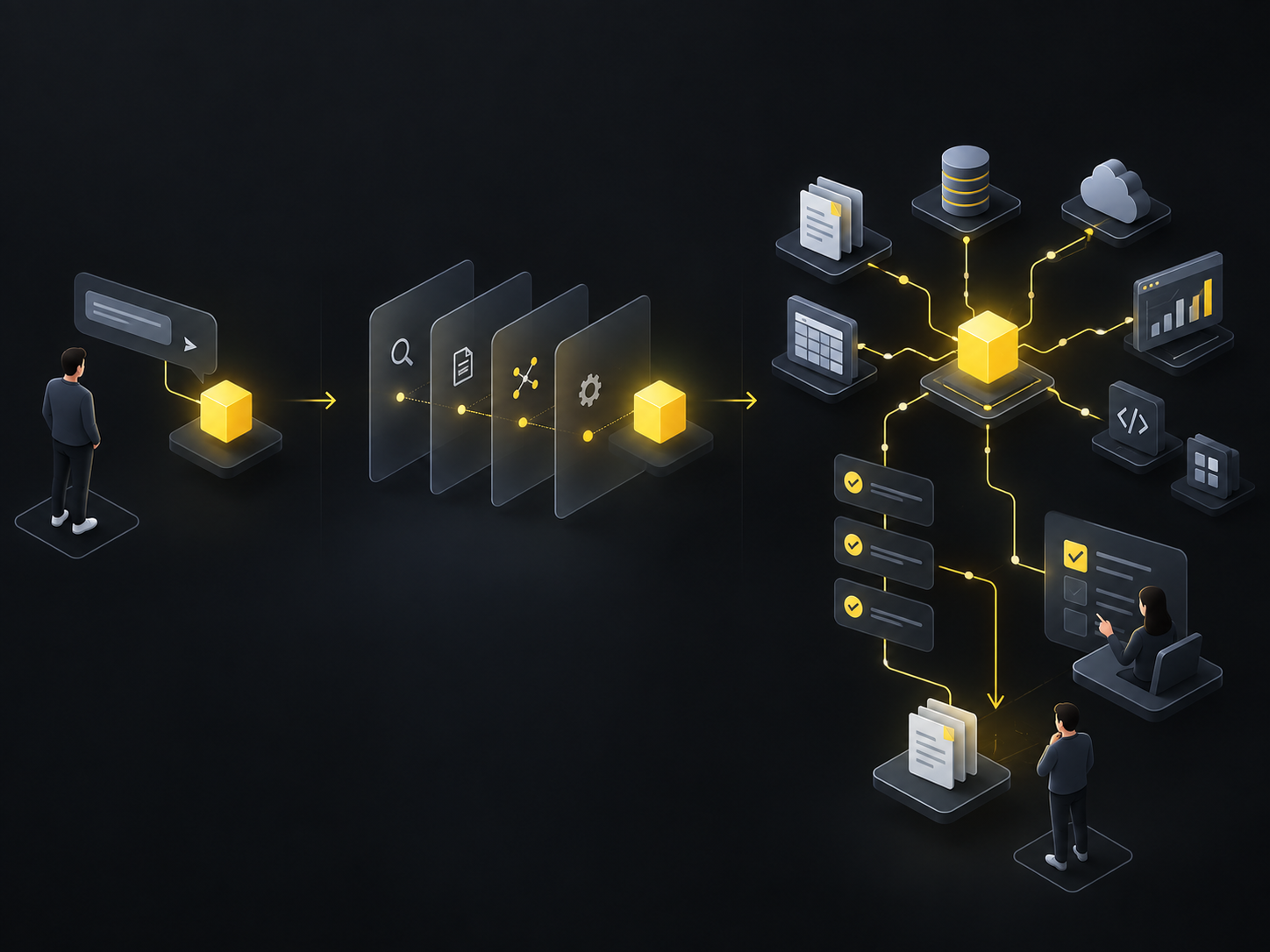
Our workshops and discovery programs connect research, workflow design, hands-on learning and experimentation around the work your team actually does.
Start with a leadership question, an operational challenge or a team ready to explore. We will shape the program around your context and what you want to achieve. For custom agents and agentic workflows, see Agentic AI for Organizations.

PROGRAM FORMATS
Choose the starting point that matches your ambition.
Programs can be delivered as focused sessions, workshops, applied sprints or a sequence of engagements. We agree the participants, preparation, activities and outputs around your objectives.
A workshop can generate direction and initial priorities. A deeper discovery sprint provides more time to investigate feasibility and prepare an implementation decision.
Any format can lead to a tangible next step: we can connect discovery and training with a scoped experiment, prototype or pilot, supported by clear responsibilities and evaluation criteria.
-
Your leadership team sees potential in AI and wants to understand where it matters for the organization. We help explore emerging capabilities, connect them to strategic priorities and frame a focused set of questions for action.
Focus: Capabilities, opportunities, organizational implications and strategic questions
Possible outputs: Shared understanding, priority themes and questions for further investigation
-
Your team has many ideas and needs to decide which are worth pursuing.
Focus: Mapping work and developing potential use cases
Possible outputs: Opportunity map, initial prioritization and next-step recommendations
-
Your organization needs a grounded pilot decision. We investigate workflows and assess opportunities against value, feasibility, data readiness, operating requirements and the consequences of error.
Focus: Interviews, workflow analysis, data and system review, feasibility exploration
Possible outputs: Prioritized use cases, requirements and a scoped pilot brief
-
People are experimenting with tools and want to become more capable and discerning. We design exercises around relevant tasks, helping participants brief AI systems, evaluate outputs, improve workflows and recognize when human judgment is essential.
Focus: Guided exercises around relevant tasks and approved tools
Possible outputs: Practical methods, example workflows and evaluation checklists
-
A service or process involves repeated handovers, fragmented knowledge or time-consuming coordination. We map the workflow and explore how people, AI and existing systems could work together.
Focus: Mapping roles, testing a focused workflow and defining human oversight
Possible outputs: Workflow prototype, observations and development priorities
-
Your organization wants to keep building its own capability.
Focus: Repeated practice, peer learning and supported experimentation
Possible outputs: Prepared internal facilitators, reusable learning materials and an experiment backlog
PRACTICAL APPLICATIONS
Begin with a real task, decision or source of friction.
The following examples are opportunities to investigate. Their suitability depends on your people, data, systems and operating context.
Manufacturing and production
Explore how AI could support access to technical knowledge, interpretation of process information, quality-review workflows or reporting.
A discovery engagement can examine a selected production workflow, identify useful information already available and define a bounded experiment with operators and technical teams.
Example questions:
Could operators find relevant procedures and technical information more easily?
Could process data help a team identify a recurring source of variation?
Where could assisted review improve a quality workflow, and what would still require expert checking?
Could reporting and coordination around production become more useful?
Knowledge-intensive teams
Explore research, document comparison, institutional knowledge retrieval and preparation of evidence-based briefs.
Example questions: Which sources should the system use? How should staff check a response? What information needs updating or organizing first?
Service and customer operations
Investigate how AI could support request handling, case preparation, staff assistance and coordination across systems.
Example questions: Where are the bottlenecks? Which actions need approval? How should an unresolved case return to a person?
Leadership and decision support
Explore how teams interpret performance, prepare reports and investigate changes in operational data.
Example questions: What decision should the information support? Which data can be trusted? How will people distinguish an observation from an inference?
Research, design and innovation
Investigate how AI could assist precedent research, concept exploration, coding, prototyping and knowledge organization.
Example questions: Where could the team explore more possibilities? Which outputs require source checking or physical testing? How will learning be documented?
OUR APPROACH
Work with your context from the beginning.
-
Clarify who will take part, what they already know and which decisions or capabilities the program should support.
Before the session: an agreed brief, audience profile and relevant preparation.
-
Use selected tasks, workflow examples and stakeholder perspectives to identify friction, dependencies and opportunities.
During discovery: a shared picture of the work and the questions worth exploring.
-
Introduce relevant AI approaches through demonstrations and guided exercises. Where appropriate, compare alternatives and examine their limitations.
During learning: practical experience, observations and a more informed view of what the tools can support.
-
Assess proposed use cases against the intended value, available evidence, technical feasibility and adoption requirements.
For decision-making: a prioritized set of opportunities and a record of assumptions and dependencies.
-
Choose a manageable next step with an owner, scope, evaluation approach and required inputs.
For action: a pilot brief, learning plan or development roadmap appropriate to the engagement.
-
Where commissioned, continue into prototyping, development, integration and evaluation. Support the internal team as it tests the approach and learns from use.
For continued progress: working experiments, feedback and evidence to guide the next stage.
LEARNING OUTCOMES
Build the judgment to use AI well.
The program is tailored to its participants. Depending on the scope, teams can develop the ability to:
Recognize where AI may contribute value and where another approach is more suitable.
Describe a task, its context and the criteria for a useful result.
Work with approved information, tools and permissions.
Check sources, accuracy, uncertainty and completeness.
Design human review, correction and escalation into a workflow.
Compare an AI-assisted approach with the existing way of working.
Define a pilot with clear responsibilities and meaningful evaluation.
Share learning and improve practices across the team.
We connect tool use with the wider decisions that make adoption useful and sustainable.
RELATED WORK
Work that informs our approach.
Tasni.ai — AI and fabrication research
A spin-off exploring software, sensor feedback and process information in robotic fabrication. It connects our AI work with physical production questions.
Nahwa — Information for organizational decisions
An IBDÅ-developed business intelligence platform combining data visualization, AI-assisted analysis, forecasting and reporting.
Vero AI — The experience of agentic customer support
IBDÅ contributed UX/UI research, design and prototyping to CME's platform, working alongside its team on the experience of AI-enabled customer operations.
Sindan UAE — Deployable structures for small satellites
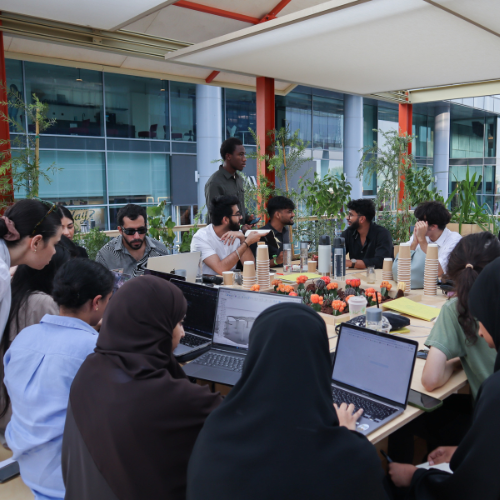
A workshop led by our co-founder, Dr. Raffi Tchakerian, for the engineering team at Sindan UAE, a space and engineering company. It covered folding techniques for nano-satellites and CubeSats, design thinking applied to space challenges, and hands-on exercises on doing more with less.
TUMO — Habitable rovers for the Moon and Mars
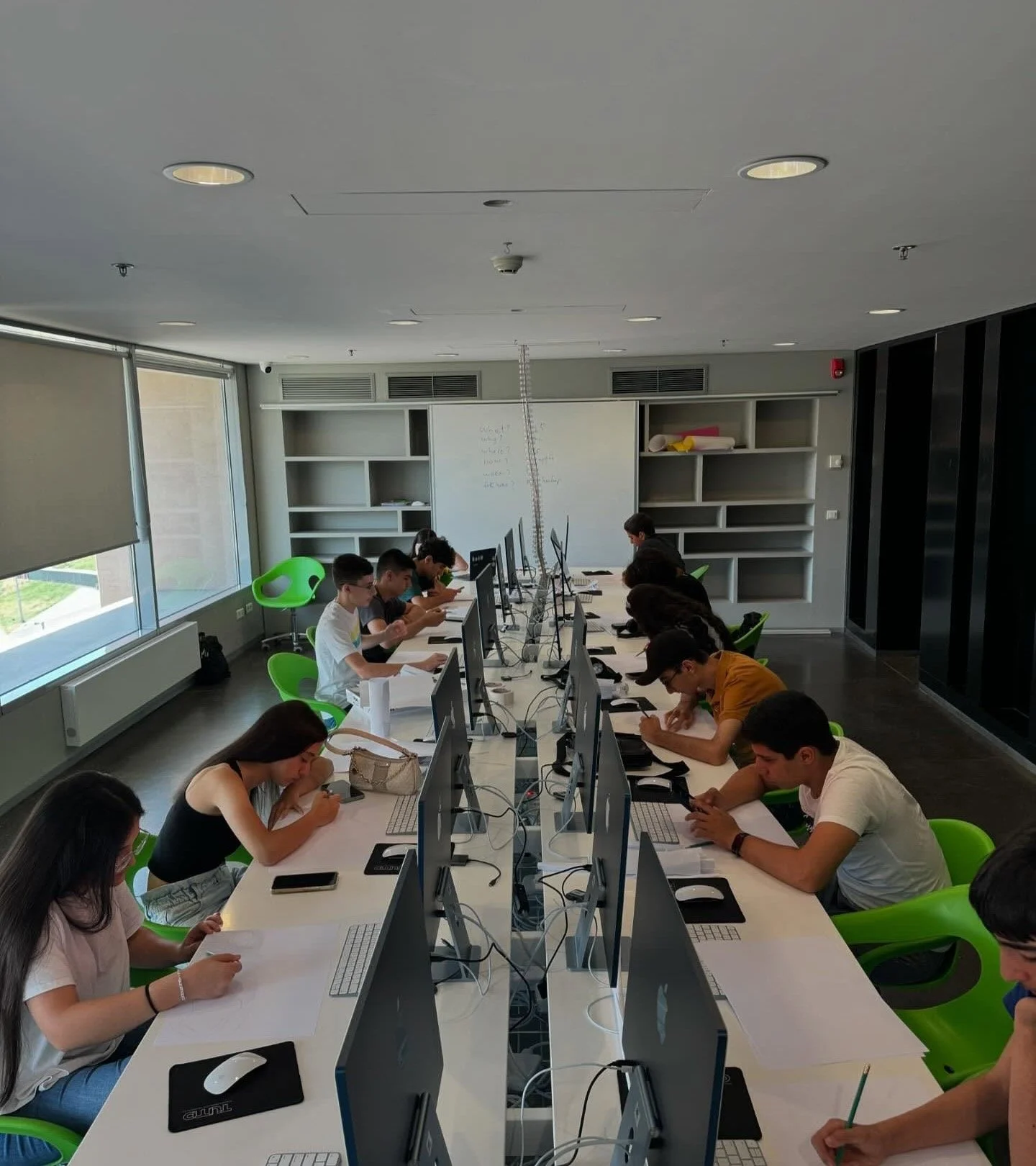
A two-week workshop led by our co-founder, Dr. Raffi Tchakerian, at the TUMO Center for Creative Technologies, with 15 young technologists designing habitable rovers for the Moon and Mars. It explored design tools, digital solutions and AI tools as ways to make an advanced topic easier to teach.
These examples illustrate related research, development and workshop experience. The content of each workshop is designed around its participants and objectives.
DELIVERY
Designed around your organization.
We work with leadership teams, innovation units, operational staff, technical specialists and multidisciplinary groups.
Programs can take place in person in Dubai, at an agreed client location or remotely. The format follows the learning goals, available time and practical needs of the team.
Preparation can include a short briefing, selected interviews, example tasks or a review of relevant workflows. Exercises can use approved organizational material or representative examples.
We agree the scope, preparation, outputs and any follow-up support before the program begins.
A useful opportunity can become a scoped development project, with the team and expertise required to build and evaluate it.
-
Yes. We can combine opportunity discovery with practical learning, so participants develop capabilities while investigating applications relevant to their work.
-
Yes. We can investigate selected workflows with management, operators and technical teams, then identify opportunities and the data, system access and expertise needed to test them.
-
No. Programs can be designed for leadership, non-technical teams or specialist audiences. Exercises and technical depth are matched to participants.
-
No. The starting point is your objective. Depending on the brief, we may explore generative AI, knowledge retrieval, data analysis, computer vision, automation or agentic workflows.
-
Yes. We can work within an agreed technology environment and account for its access, data and integration requirements.
-
A prototype can be included in an applied sprint or development engagement. A focused introductory workshop usually produces learning, opportunities and next steps. The proposal makes the expected outputs explicit.
-
Yes. We can continue through research, product and workflow design, prototyping, software and AI development, integration and testing, with responsibilities and delivery phases agreed around the project.
-
Pricing depends on preparation, audience, format, technical depth, agreed outputs and follow-up work. We scope the program after understanding your objectives and provide a proposal.
FAQ
Questions you may have
•
opportunity discovery
•
workflow design
•
hands-on learning
•
experimentation
•
prioritization
•
human oversight
•
pilot planning
•
capability building
• opportunity discovery • workflow design • hands-on learning • experimentation • prioritization • human oversight • pilot planning • capability building
START A PROJECT
What would your team explore if it knew where to begin?
Tell us about the work, the people involved and the change you want to make. We will help define a useful starting point.